本文用于记录在使用 Python 过程中不知道的类装饰器的用法与功能。
@dataclass
 1
 2
 3
 4
 5
 6
 7
 8
 9
10
11
12
13
| """Add dunder methods based on the fields defined in the class.
Examines PEP 526 __annotations__ to determine fields.
If init is true, an __init__() method is added to the class. If repr
is true, a __repr__() method is added. If order is true, rich
comparison dunder methods are added. If unsafe_hash is true, a
__hash__() method is added. If frozen is true, fields may not be
assigned to after instance creation. If match_args is true, the
__match_args__ tuple is added. If kw_only is true, then by default
all fields are keyword-only. If slots is true, a new class with a
__slots__ attribute is returned.
"""
|
根据类中字段的定义,给类添加魔法方法:
- 如果 init 为 True,则会为类添加一个
__init__() 方法 - 如果 repr 为 True,则会添加一个
__repr__() 方法 - 如果 order 为 True,则会添加用于大小比较的魔法方法
- 如果 unsafe_hash 为 True,则会添加一个
__hash__() 方法 - 如果 frozen 为 True,则在实例创建后,不允许修改字段的值
- 如果 match_args 为 True,则会添加
__match_args__ 元组 - 如果 kw_only 为 True,则默认所有字段都是仅限关键字参数
- 如果 slots 为 True,则会返回一个带有
__slots__ 属性的新类
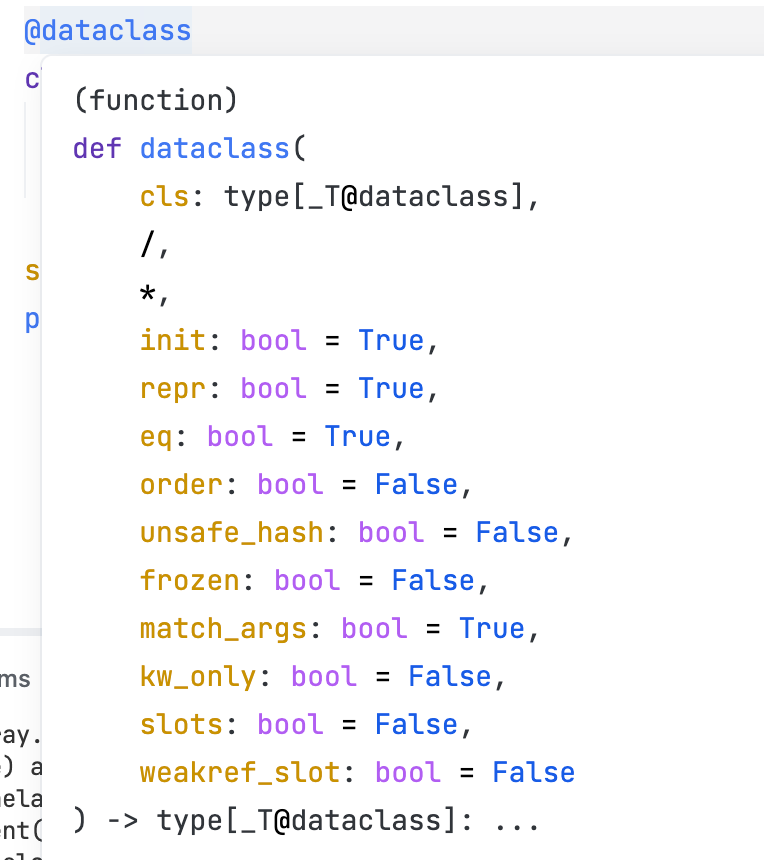
@dataclass 的声明如下:

在不传入参数的情况下,默认会增加 3 个魔法方法:
__init__()__repr__()__eq__()
示例如下:
 1
 2
 3
 4
 5
 6
 7
 8
 9
10
11
12
| from dataclasses import dataclass
@dataclass
class Student:
name: str
age: int
student = Student(name="Joe", age=28)
print(student.__repr__()) # Student(name='Joe', age=28)
student2 = Student(name="Joe", age=28)
print("equal:", student == student2) # equal: True
|
@property
@property 把类的方法当作属性调用,可以实现只读、属性校验、动态计算属性。
 1
 2
 3
 4
 5
 6
 7
 8
 9
10
11
12
13
14
15
16
17
18
19
20
21
| class User:
def __init__(self, age: int):
self._age = age
@property
def age(self):
return self._age
@age.setter
def age(self, value: int):
if value < 0:
raise ValueError("年龄不能小于0")
if value > 120:
raise ValueError("年龄不能大于120")
self._age = value
user = User(18)
print(user.age)
user.age = 120
print(user.age)
|
@staticmethod
@staticmethod 声明方法为静态方法,无需实例即可调用。
1
2
3
4
5
6
7
| class Math:
"""数学工具类"""
@staticmethod
def add(a: int, b: int) -> int:
return a + b
print(Math.add(1, 2))
|
@classmethod
@classmethod 把方法变成类方法,常用于工厂方法和多构造函数。
- 第一个参数为类本身,cls
- 直接
类名.方法名() 调用
 1
 2
 3
 4
 5
 6
 7
 8
 9
10
11
12
13
14
15
16
17
18
19
20
21
22
23
| class Product:
"""产品类"""
def __init__(self, name: str, price: float):
self.name = name
self.price = price
@classmethod
def default(cls) -> "Product":
return cls("default", 0.0)
@classmethod
def create(cls, name: str, price: float) -> "Product":
return cls(name, price)
default_product = Product.default()
print(default_product.name)
print(default_product.price)
product = Product.create("test", 100.0)
print(product.name)
print(product.price)
|
@abstractmethod
多态设计
@abstractmethod 用于定义抽象方法,必须配合抽象基类 ABC 使用,作用如下:
- 子类必须实现父类定义的抽象方法
- 定义接口约束
 1
 2
 3
 4
 5
 6
 7
 8
 9
10
11
12
13
14
15
16
17
18
19
| from abc import ABC, abstractmethod
class Animal(ABC):
"""动物类"""
@abstractmethod
def sound(self) -> str:
"""动物的叫声"""
pass
class Dog(Animal):
"""狗类"""
def sound(self) -> str:
return "汪汪汪"
dog = Dog()
print(dog.sound())
|